
All-Party Parliamentary Group (APPG) for Critical Minerals: International Alignment – 19 March, House of Lords


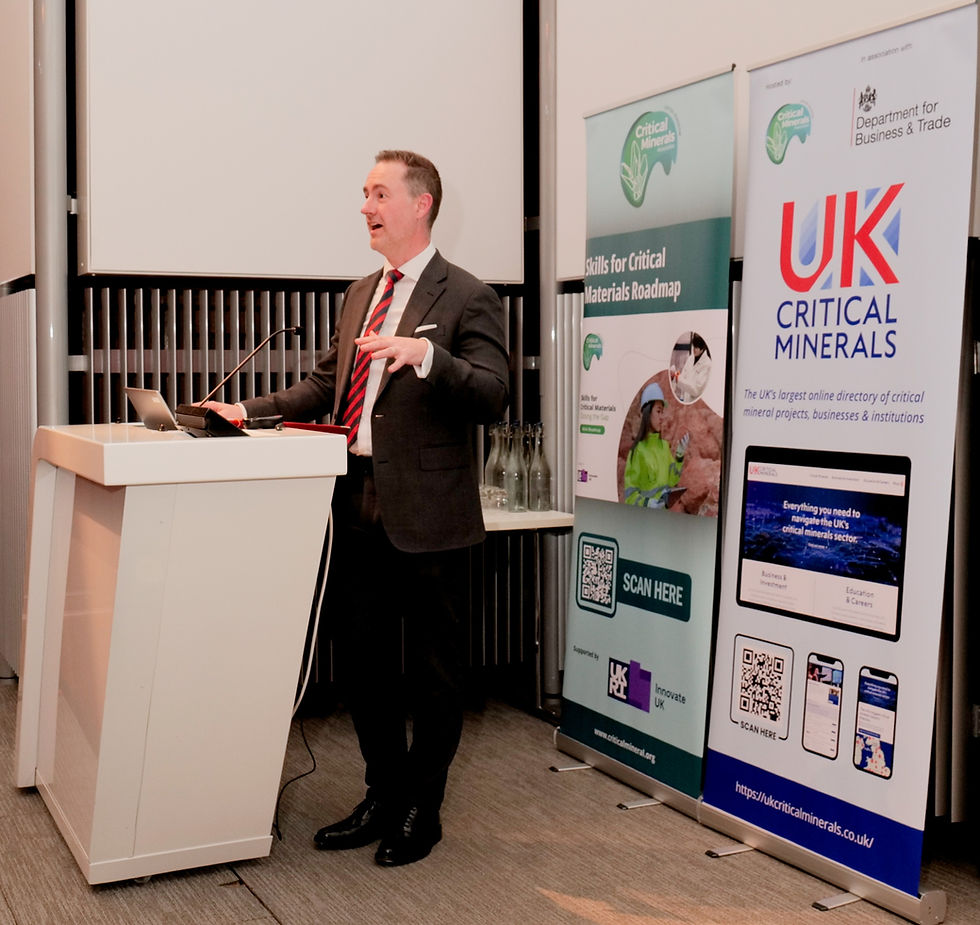
On Thursday 19 March, the All-Party Parliamentary Group (APPG) for Critical Minerals convened in the House of Lords to discuss the importance of international alignment in securing resilient and responsible critical mineral supply chains.
The session brought together representatives from government, industry, and finance to explore the geopolitical dynamics shaping global supply chains, as well as the UK’s role within an increasingly volatile international landscape. The discussion forms part of the APPG’s ongoing work to support understanding of the UK’s position within the sector, and how it can better leverage its strengths and bolster its capabilities to meet the goals of the Modern Industrial Strategy and the Critical Minerals Strategy: Vision 2035.
The session featured contributions from:
Noah Law MP - Co-Chair of the APPG for Critical Minerals
Baroness Northover- Co-Chair of the APPG for Critical Minerals
Perran Moon MP - Officer of the APPG for Critical Minerals
Amanda van Dyke - Founder & Managing Director, Critical Minerals Hub
Jeff Townsend - Chairman & Co-Founder, Critical Minerals Association
Mike Hill - Deputy Director for Critical Minerals, Department for Business and Trade (DBT)
A wider group discussion followed, with contributions from stakeholders across the critical mineral ecosystem.
Global Demand and Structural Pressures
Participants discussed the scale of the long-term demand challenge facing global supply chains. Over the past 25 years, global metals and minerals output has more than doubled, reflecting sustained industrial growth and technological development.
Even excluding the needs of the energy transition, demand is expected to rise significantly. With the proliferation of artificial intelligence and data centres, defence innovation and advanced manufacturing, supply requirements are projected to increase substantially, placing additional pressure on already constrained markets.
Emerging deficits in key materials, ongoing geopolitical and market shocks, and the continued importance of mined inputs such as fertilisers for sustaining global food systems, highlight the systemic importance of securing and diversifying supply chains.
Geopolitical Dynamics and Market Concentration
A key theme of the discussion was the concentration of global processing capacity. China’s dominant position, particularly in midstream processing and refining, was highlighted as a defining feature of the current system, and one that has repercussions for the rest of the supply chain.
China’s concentration has implications not only for market dynamics but for geopolitical resilience. Its 2025 export controls on rare earth elements, battery materials, and graphite technologies extended beyond raw materials to encompass components, equipment, and manufacturing know-how. By requiring licences for products containing Chinese inputs, these measures demonstrated how supply chain dependencies can translate into strategic leverage across sectors including defence, semiconductors, and energy systems.
International Responses and Policy Approaches
Participants reflected on the differing approaches being taken across major economies. The United States was noted for its pace and level of coordination, particularly in mobilising capital and establishing international partnerships.
In contrast, while Europe has made progress in recognising the strategic importance of critical minerals, implementation challenges remain, including regulatory complexity and slower decision-making processes.
There was broad discussion around the role of government in supporting supply chain development. While markets remain central, participants noted that public policy and targeted financial support are increasingly important in enabling projects to move forward – particularly for long-term projects where commercial returns alone may not be sufficient to attract private investment in the short term. With global competition intensifying and countries such as China and the United States accelerating state-backed investment, participants stressed that delays in policy action risk leaving supply chains exposed and strategically dependent for years to come.
The UK’s Role in the International Landscape
The UK’s position within global critical mineral supply chains was considered in the context of its broader industrial strategy. While domestic extraction opportunities are limited, the UK was recognised for its strengths in:
Expertise and infrastructure for midstream processing and refining
Financial services and project financing
Research, innovation, and circular economy capabilities
These capabilities align with the UK’s strategic focus on building resilience through international partnerships, capability development via domestic production and recycling, and expanding domestic capabilities across key stages of the supply chain, particularly in processing and manufacturing, to reduce reliance on externally sourced materials and components.
Participants also discussed the importance of ensuring that UK-based industries are effectively integrated into global supply chains, with particular emphasis on securing reliable access to materials for downstream sectors such as automotive and defense manufacturing. In this context, participants highlighted the importance of offtake agreements in de-risking projects, as long-term purchase commitments provide revenue certainty and improve the bankability of projects, making it easier to attract blended and private financing.
Investment, Finance, and Market Structure
Access to finance was identified as a critical enabler of supply chain development. Participants noted that capital-intensive projects, combined with relatively modest returns in some parts of the value chain, can create barriers to attracting private investment.
The role of public financial institutions and export finance mechanisms was discussed in supporting both domestic and international projects that contribute to UK supply security.
There was also recognition of the UK’s historic role as a centre for mining finance, and the potential to strengthen this position to support global project development and meet growing demand.
Strengthening Coordination and Alignment
The importance of greater international coordination was a recurring theme throughout the discussion. While there is increasing recognition of the strategic importance of critical minerals, alignment between international partners remains a work in progress.
Initiatives such as supply chain mapping, multilateral engagement, and demand aggregation were highlighted as tools to improve visibility and coordination across the value chain.
Participants also discussed the potential role of standards and market frameworks in supporting responsible sourcing and ensuring a level playing field in global markets.
Noah Law MP, Co-Chair of the APPG for Critical Minerals noted: “Ultimately, critical minerals is not an industry you half commit to. You either do it and accept an element of cross-subsidisation – both through the value chain and over time – to build it; or you don't bother. Massive progress has been made since the Critical Minerals Strategy, but our UK Government now needs to decide if it is ready to go all-in. The firmer the commitment, the lower the fundamental risk.”
Conclusion
The meeting highlighted the growing importance of international alignment in addressing the challenges facing critical mineral supply chains. As demand continues to rise and geopolitical competition intensifies, coordinated action across government, industry, and finance will be essential.
The APPG will continue to provide a forum for stakeholders to engage on these issues, supporting the development of policies that strengthen the UK’s resilience, competitiveness, and role within the global critical minerals landscape.

Article written by Elliott Trickey, Government Affairs Associate, CMA (UK)


Comments